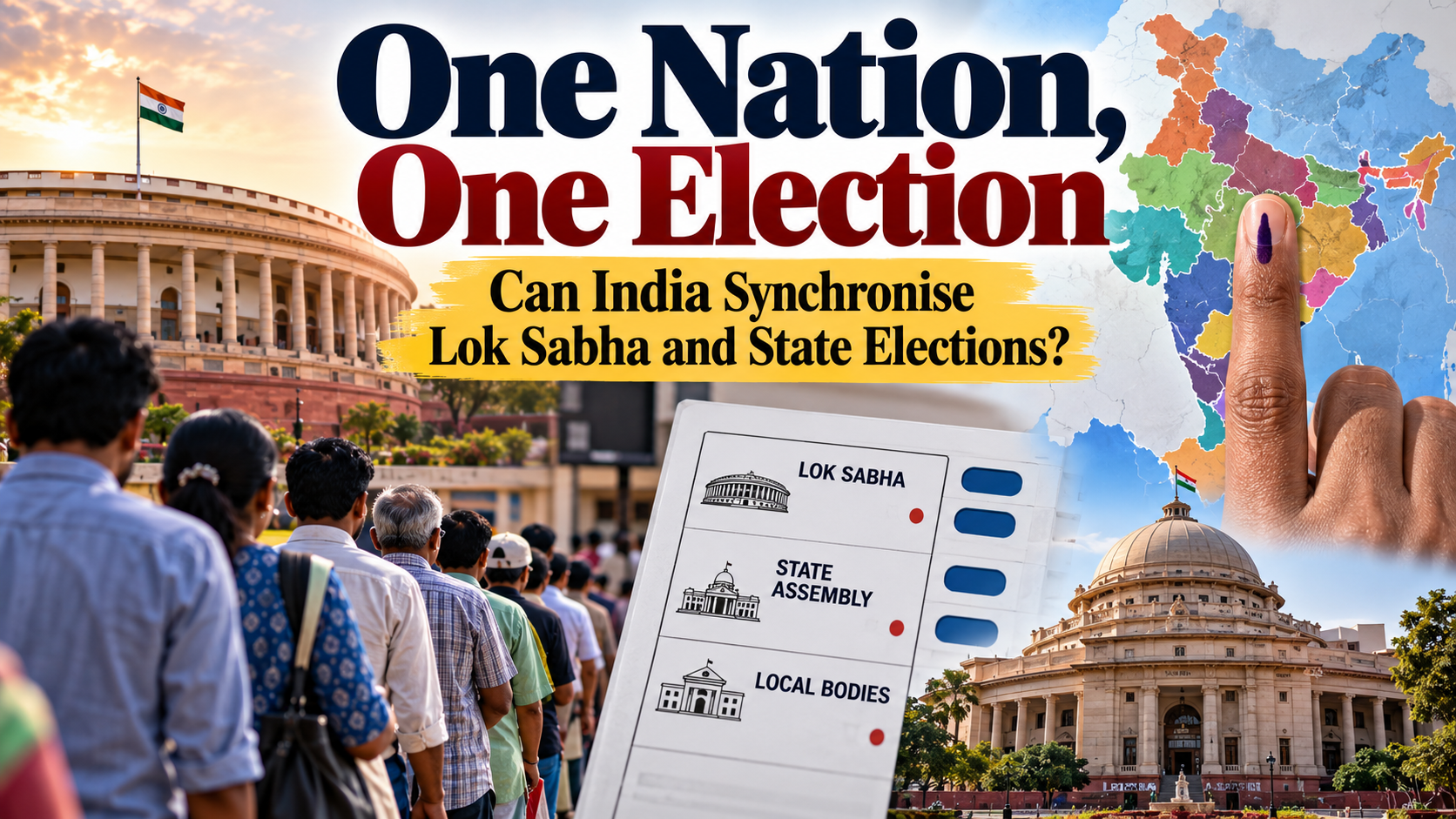
One Nation, One Election: Can India Synchronise Lok Sabha and State Elections?
India has a rather unusual relationship with elections.
For much of the year, political parties are preparing for one election or another. One State may be voting while another is preparing for its campaign. By the time the results are announced in one part of the country, political activity may already be picking up somewhere else.
For voters, this has become a familiar part of democratic life.
For governments and political parties, however, it means a continuous cycle of campaigns, rallies, security arrangements and administrative preparation.
It is against this background that the idea of “One Nation, One Election”, or simultaneous elections, has returned to the centre of India's political debate.
The basic idea is simple enough. Elections to the Lok Sabha and State Legislative Assemblies would be brought into a common electoral cycle rather than being held at different times.
But the simplicity ends there.
India is a federal parliamentary democracy. The Union government and State governments have separate constitutional responsibilities, and their legislatures do not necessarily complete their terms at the same time.
Governments can fall.
Assemblies can be dissolved.
Coalitions can break.
A new government can be formed.
So the real question is not simply whether India can hold several elections together.
It is whether the country can create a system in which elections remain synchronised without weakening the constitutional role of Parliament, State Legislatures and voters.
That is what makes the debate over One Nation, One Election far more complicated than the slogan suggests.
India Has Seen Simultaneous Elections Before
There is an important historical point that often gets lost in today's debate.
Simultaneous elections are not entirely new to India.
From the first general elections in 1951–52 until the late 1960s, Lok Sabha and State Assembly elections were largely held together. The electoral cycle gradually broke down as governments and Assemblies were dissolved at different points in time.
The result is the system India has today, where elections take place at different times across different States.
The official One Nation, One Election website notes that Lok Sabha and State Assembly elections were conducted largely together between 1951–52 and 1967, after which the cycle was disrupted.
So the current proposal is not an attempt to invent an entirely new electoral practice.
In many ways, it is an attempt to recreate a system that existed during the early years of the Republic, although today's political and constitutional circumstances are considerably more complicated.
India now has a much larger electorate, a far more competitive party system and a much stronger regional political presence.
That makes the question of synchronisation much harder than it was in the early decades after Independence.
What Does “One Nation, One Election” Actually Mean?
The phrase can be slightly misleading.
It does not necessarily mean that every election in the country, including municipal and panchayat elections, must take place on exactly the same day.
The framework proposed by the High-Level Committee on Simultaneous Elections envisages a phased approach.
The first stage would involve synchronising elections to the Lok Sabha and State Legislative Assemblies.
The second stage would involve bringing elections to municipalities and panchayats into alignment within a specified period.
The committee recommended that local-body elections be held within 100 days of the Lok Sabha and State Assembly elections.
The distinction is important because it shows that the proposal is about creating a common electoral cycle, rather than putting every polling booth in India into one enormous nationwide election day.
The High-Level Committee's report contains detailed recommendations on the proposed implementation framework, constitutional changes and logistical requirements.
The Kovind Committee
The present debate received a major institutional push after the Union government established the High-Level Committee on Simultaneous Elections in September 2023.
Former President Ram Nath Kovind headed the committee.
The panel examined whether simultaneous elections could be introduced within India's existing constitutional framework and, where necessary, what legal and constitutional changes would be required.
It also consulted political parties, constitutional experts, administrators and other stakeholders.
The committee looked at issues that go well beyond election dates.
It considered the financial cost of elections, deployment of security forces, availability of election equipment, voter participation, the Model Code of Conduct, premature dissolution of legislatures and the constitutional relationship between the Union and the States.
The committee's terms of reference specifically required it to examine what should happen in situations such as a hung House, a no-confidence motion, defection or other circumstances that could disrupt the electoral cycle.
That is where the real difficulty begins.
The Constitutional Amendment Bill
The proposal moved from discussion to legislation when the government introduced the Constitution (One Hundred and Twenty-Ninth Amendment) Bill, 2024 in the Lok Sabha.
The Bill seeks constitutional changes intended to provide a framework for simultaneous elections.
Among other provisions, it proposes the insertion of Article 82A and changes to Articles 83, 172 and 327.
But there is an important point that should not be overlooked.
The proposal is not yet law.
The Bill was referred to a Joint Committee of Parliament for detailed examination. Parliamentary records continue to list the committee examining the Bill, and meetings with stakeholders are scheduled in October 2026.
So claims that India has already adopted One Nation, One Election would be incorrect.
As of October 2026, the country is still in the legislative and consultation stage.
Why Supporters Want Simultaneous Elections
The strongest argument in favour of simultaneous elections is administrative efficiency.
India's elections require a huge mobilisation of resources.
Election officials have to be trained and deployed. Security personnel are moved across States. Electronic voting machines and VVPAT units have to be transported and stored. Schools and government buildings are frequently used as polling centres.
Political parties also spend large amounts of time and money campaigning.
When elections happen repeatedly, many of these activities have to be organised again and again.
The High-Level Committee has identified the reduction of repeated administrative and logistical burdens as one of the potential advantages of simultaneous elections.
Supporters also argue that governments could spend more time focusing on policy and implementation instead of constantly preparing for the next election.
That argument has some practical appeal.
But it should not be treated as proof that simultaneous elections would automatically solve every administrative problem.
A nationwide simultaneous election would itself be an enormous logistical operation.
The Election Commission would need enough voting machines, VVPAT units, trained personnel, security arrangements, storage facilities and transportation resources to conduct elections across the country within a common cycle.
So the question is not simply whether simultaneous elections reduce costs.
It is also about what the cost of implementing the new system would be.
What About the Model Code of Conduct?
The Model Code of Conduct is another important part of the discussion.
When elections are announced, the Code comes into effect in the areas going to the polls. It lays down standards intended to prevent the misuse of government machinery and to maintain a level playing field between political parties and candidates.
Because State elections take place at different times, the Model Code can come into effect repeatedly in different parts of the country.
Supporters of simultaneous elections argue that a common electoral cycle could reduce the repeated interruptions associated with election periods.
There is a practical argument here.
However, the Model Code exists for a reason.
The objective of any electoral reform cannot simply be to make government decision-making more convenient.
It must also protect the fairness of elections.
A shorter period of electoral restrictions may be administratively convenient, but the safeguards associated with elections cannot be weakened merely for convenience.
The Money Question
Election expenditure is another major part of the debate.
Political parties spend money on advertising, rallies, campaign travel, communication and organisational activities.
Candidates also face campaign expenses.
Holding elections repeatedly means that political parties have to mobilise resources repeatedly.
The High-Level Committee examined the financial implications of simultaneous elections as part of its report.
But the financial argument requires some caution.
A simultaneous election covering the entire country would be one of the largest administrative exercises imaginable.
It would require additional equipment and substantial preparation.
Therefore, it would be more accurate to say that simultaneous elections could change the pattern of election expenditure, rather than simply assuming that the country would automatically save a particular amount of money.
The actual financial outcome would depend on how the system is designed and implemented.
The Federalism Question
This may be the most important concern surrounding the proposal.
India is not a unitary country.
The Constitution divides powers between the Union and the States.
A voter choosing a State government is not necessarily thinking about the same issues as a voter choosing the Union government.
In a State election, issues such as roads, local infrastructure, agriculture, education, healthcare, law and order and State-level welfare programmes can dominate political discussions.
A Lok Sabha election, meanwhile, may involve national questions such as foreign policy, defence, national economic policy and the performance of the Union government.
Holding both elections together could create a situation in which national political narratives receive greater attention during State campaigns.
Would voters still distinguish between the two?
There is no simple answer.
Indian voters have repeatedly demonstrated that they can vote differently in Lok Sabha and Assembly elections, even when those elections are held relatively close together.
That suggests that voters are capable of making separate choices.
At the same time, it would be difficult to completely ignore the influence that a nationwide campaign could have on State-level contests.
This is one of the central questions that policymakers need to consider.
What Happens If a State Government Falls?
This is where the proposal becomes much more complicated.
Imagine that simultaneous elections are held and a State government is formed.
Two years later, the government loses its majority.
Under India's existing parliamentary system, the political process allows for a change of government and, where necessary, fresh elections.
But what happens under a synchronised system?
If a fresh election is held immediately, the common electoral cycle could be disrupted.
If the newly elected Assembly is given only the remaining period of the original electoral cycle, its term could be shorter than five years.
That creates another question.
If voters elect a new government, should that government be told in advance that it may have to face another election much sooner simply because of the national electoral calendar?
The High-Level Committee specifically examined situations involving premature dissolution and the need to preserve the simultaneous-election cycle.
There is no easy solution.
But any workable model will have to answer this question clearly.
What If the Lok Sabha Falls Early?
The same issue exists at the national level.
Suppose a Lok Sabha is elected as part of the simultaneous cycle.
A coalition later loses its majority.
The government falls.
A new government cannot be formed.
What happens then?
A fresh Lok Sabha election may become necessary.
But another election could disrupt the entire synchronised cycle.
This is not a minor technical problem.
It goes directly to the basic principle of parliamentary government: a government must retain the confidence of the House.
A system of simultaneous elections cannot prevent constitutional political change simply to protect an election timetable.
At the same time, if every premature dissolution immediately results in a separate election, the purpose of synchronisation could gradually disappear.
Finding the balance between these two requirements is perhaps the biggest constitutional challenge.
Regional Parties and State-Level Politics
India's political landscape cannot be understood without regional parties.
Many States have political parties whose influence is primarily based on regional identity, local issues and State-level governance.
For such parties, the campaign environment of a simultaneous Lok Sabha and Assembly election could be very different from the current system.
A nationwide election would naturally attract significant attention from national political parties.
The possibility exists that State-level issues could receive less attention in a campaign dominated by national leaders and national debates.
On the other hand, regional parties have strong local organisations and established voter bases.
Indian politics has also shown many examples of voters making different choices in parliamentary and Assembly elections.
So it would be premature to assume that simultaneous elections would automatically reduce the influence of regional parties.
The more reasonable conclusion is that the electoral environment would change, and the exact effect would depend on the State, the political competition and the issues involved.
Would Voters Find It Easier?
There is also a voter perspective.
A synchronised election calendar could make the electoral system easier to understand.
Instead of constantly hearing about upcoming elections in different States, voters would have a more predictable cycle.
The High-Level Committee has also identified voter convenience and the possibility of reducing voter fatigue among the potential advantages of simultaneous elections.
But there is another side.
Elections provide citizens with opportunities to evaluate governments.
If a State government performs poorly, an election allows voters to express their judgement.
If elections are tied to a common cycle, voters may have fewer opportunities to make that judgement outside the fixed timetable.
That does not mean a synchronised system would necessarily weaken accountability.
It means the system would need other mechanisms to ensure that governments remain answerable throughout their terms.
More Elections Do Not Automatically Mean Better Democracy
It is tempting to think that fewer elections must be better because elections cost money and consume administrative resources.
It is equally tempting to argue that more elections automatically mean stronger democracy.
Neither assumption is sufficient.
Elections are essential because they allow citizens to choose representatives and remove governments.
But democracy also depends on institutions between elections.
Parliamentary scrutiny, courts, legislatures, media, civil society and public debate all play important roles.
The real question is therefore not simply whether India should have more or fewer elections.
The question is whether the electoral calendar can be organised in a way that balances efficiency, accountability and federalism.
What Can India Learn From Other Countries?
There is no single international model that India can simply copy.
Different countries organise elections according to their own constitutional arrangements.
Some have fixed election cycles.
Others allow early elections under particular circumstances.
Some hold different elections simultaneously, while others deliberately separate them.
The High-Level Committee examined international examples, including countries such as South Africa, Sweden, Belgium, Germany, Indonesia and the Philippines.
But India's constitutional structure is unique.
The country has a parliamentary system, a federal distribution of powers, a huge electorate and hundreds of political parties operating at national, State and local levels.
Therefore, an international example may provide useful lessons, but it cannot provide a ready-made solution.
The Election Commission's Challenge
If simultaneous elections are eventually introduced, the Election Commission of India would face an enormous logistical task.
Consider what would need to be coordinated.
Millions of election officials would require training and deployment.
Security personnel would need to be available across the country.
Voting machines and VVPAT equipment would have to be procured, transported and stored.
Polling stations would have to be prepared.
Election schedules would need to account for India's geography and security requirements.
Counting arrangements would also have to be coordinated.
The High-Level Committee specifically examined logistical and manpower requirements, including EVMs and VVPAT units, as part of its terms of reference.
The scale of the exercise means that implementation could not be rushed.
Infrastructure would need to be prepared well in advance.
Electoral Rolls Matter Too
Synchronising elections would also increase the importance of accurate electoral rolls.
If voters are expected to participate in multiple elections during the same cycle, the electoral database needs to be reliable and regularly updated.
The High-Level Committee examined the possibility of a single electoral roll and voter identity framework for different levels of elections.
This is another area where technology can help, but technology alone cannot solve administrative problems.
The system still needs accurate data, effective verification and accessible procedures for citizens to correct mistakes.
An electoral reform of this scale ultimately depends on the quality of the basic voter-registration system.
Does the Constitution Need to Change?
Yes, significant constitutional and legal changes would be required for the proposed system.
That is why the Constitution (129th Amendment) Bill is so important.
The proposed framework involves changes relating to the duration and synchronisation of legislatures.
The High-Level Committee's report also examined changes to constitutional provisions and election laws that would be required for implementation.
But constitutional amendment is only one part of the process.
The practical rules would also have to be worked out through legislation, election regulations and administrative arrangements.
The reform would therefore affect much more than the date of elections.
It would change how India's electoral cycle itself is structured.
The Basic Structure Question
Another constitutional issue is India's Basic Structure Doctrine.
The doctrine places limits on Parliament's power to amend the Constitution by protecting certain fundamental features of the constitutional system.
Questions about federalism and democratic representation are therefore relevant to the discussion.
This does not mean that simultaneous elections are automatically unconstitutional.
It means that any constitutional changes must be carefully examined in light of the Constitution's fundamental structure.
The parliamentary committee has been examining constitutional issues connected with the proposal, including questions related to federalism and the Basic Structure Doctrine.
This is one reason the reform requires detailed parliamentary scrutiny rather than a quick political decision.
How Would the Transition Work?
This may be the least visible but most difficult part of the entire proposal.
State Assemblies across India do not currently have identical terms.
Some have elections coming earlier.
Others have elections later.
Bringing them into a common cycle would therefore require a transition.
Some Assembly terms could potentially need to be shortened or otherwise adjusted.
That raises an obvious democratic question.
An Assembly elected for five years receives a constitutional mandate from voters.
How should that mandate be treated if the country wants to create a common election cycle?
The answer would need to be established clearly in the constitutional framework.
There should be no ambiguity about how long elected governments are expected to serve.
What Is the Current Status?
As of October 2026, One Nation, One Election remains under parliamentary consideration.
The Constitution (One Hundred and Twenty-Ninth Amendment) Bill, 2024 was referred to a Joint Committee of Parliament after being introduced in the Lok Sabha.
The committee continues to examine the proposal and has been conducting consultations.
Parliament's official committee schedule lists further meetings in October 2026, including interactions with media representatives and economists concerning the two Bills connected with simultaneous elections.
This is important because public discussion sometimes gives the impression that a final implementation date has already been decided.
It has not.
The legislative process is still underway.
What Could a Practical Model Look Like?
If India eventually adopts simultaneous elections, the success of the system will depend heavily on the safeguards built into it.
The rules dealing with a government losing its majority will be particularly important.
There would need to be a clear constitutional process for situations involving a hung House, a no-confidence motion or premature dissolution.
The system would also need adequate safeguards for State-level accountability.
The Election Commission would require sufficient equipment, personnel and funding.
Political parties would need clarity about campaign rules.
Voters would need clear information about the new electoral system.
And the transition from the existing staggered system to a common cycle would need to be carefully planned.
In other words, the success of One Nation, One Election would depend less on the slogan and more on the details.
The Debate Is Bigger Than Election Dates
At first glance, One Nation, One Election appears to be a question about scheduling.
It is actually a question about the structure of Indian democracy.
Changing the electoral cycle could affect the relationship between voters and governments.
It could influence campaign strategies.
It could alter the way national and State issues are discussed.
It could change the administrative demands placed on the Election Commission.
It could affect regional political parties.
And it could require significant constitutional amendments.
That is why the proposal deserves serious discussion from more than one perspective.
Efficiency Versus Accountability
The strongest argument for simultaneous elections is efficiency.
The strongest concern is accountability.
Both deserve to be taken seriously.
A government that spends too much time preparing for elections may have less administrative space for long-term policy.
But a government that knows it cannot face voters until a fixed common election cycle may also have fewer immediate electoral incentives to respond to public dissatisfaction.
The challenge is to find a model where administrative efficiency does not come at the cost of democratic accountability.
That balance will determine whether simultaneous elections become a meaningful institutional reform or simply a change in the election calendar.
What Should the Public Debate Focus On?
The discussion would be more useful if it moved beyond slogans.
Instead of simply asking whether people support or oppose One Nation, One Election, several practical questions deserve attention.
How should premature dissolution be handled?
What happens when a government loses its majority?
Should a newly elected Assembly have a shorter term during the transition?
How will State-specific political issues be protected during simultaneous campaigns?
How much additional equipment will the Election Commission require?
What safeguards will protect the independence and fairness of elections?
How will the rights of voters be protected if electoral rolls contain errors?
What role will regional parties have in the new system?
And what constitutional safeguards will prevent the common election cycle from becoming more important than the mandate given by voters?
These questions are more important than the slogan itself.
A Reform That Cannot Be Rushed
There is a natural attraction to the idea of simplifying a complicated system.
India's election calendar can certainly be demanding.
But constitutional reforms are different from ordinary administrative changes.
Once a new electoral system is established, changing it again could be extremely difficult.
That is why the current parliamentary examination matters.
The Joint Committee has been consulting different groups and examining the constitutional and practical implications of the proposal.
A reform affecting every State and the Union government should have enough time for serious scrutiny.
Political parties may disagree.
Constitutional experts may disagree.
State governments may have different concerns.
That disagreement is not necessarily a weakness.
It is part of the democratic process through which a major constitutional reform should be examined.
Conclusion
One Nation, One Election is not simply about making elections happen on the same day.
It is about deciding whether India's democratic system should move from a staggered electoral calendar towards a common cycle.
There are understandable arguments on both sides.
Simultaneous elections could potentially reduce repeated administrative mobilisation, campaign costs and disruptions associated with frequent elections. The High-Level Committee on Simultaneous Elections has identified several such potential advantages.
At the same time, the proposal raises serious questions about federalism, State-level accountability, premature dissolution of governments, the role of regional parties and the practical ability of the Election Commission to manage such a large electoral exercise.
The difficult part is not conducting two ballots on the same day.
The difficult part is deciding what happens after the elections.
What happens when a government falls?
What happens when a coalition breaks?
What happens when voters want to change a State government before the national election cycle ends?
And how can the country preserve the constitutional distinction between the Union and the States?
These questions need clear answers before the system can work in practice.
As of October 2026, the proposal remains under parliamentary examination. The Constitution (129th Amendment) Bill, 2024 is with a Joint Committee, which continues to consult stakeholders and examine the details of the proposed framework.
That means the final shape of One Nation, One Election is not yet settled.
Perhaps that is exactly how such a major reform should proceed.
India does not need a rushed answer.
It needs a workable one.
If simultaneous elections are eventually introduced, the success of the system will not be measured simply by how many elections are held at once.
It will be measured by whether voters continue to have a meaningful voice, whether State governments remain accountable to their own electorates, whether Parliament retains its constitutional role and whether the Election Commission can conduct elections fairly and efficiently.
In the end, the real challenge is not “One Nation, One Election.”
It is finding a way to achieve greater electoral efficiency without losing the democratic accountability that makes elections meaningful in the first place.

Well-explained article. It is very easy to understand and written in a simple, natural, and clear way.
Thank you, Ma’am. Please continue to support our GC News platform. Your support and encouragement mean a lot to us.
One nation one election would be more like dictatorship?