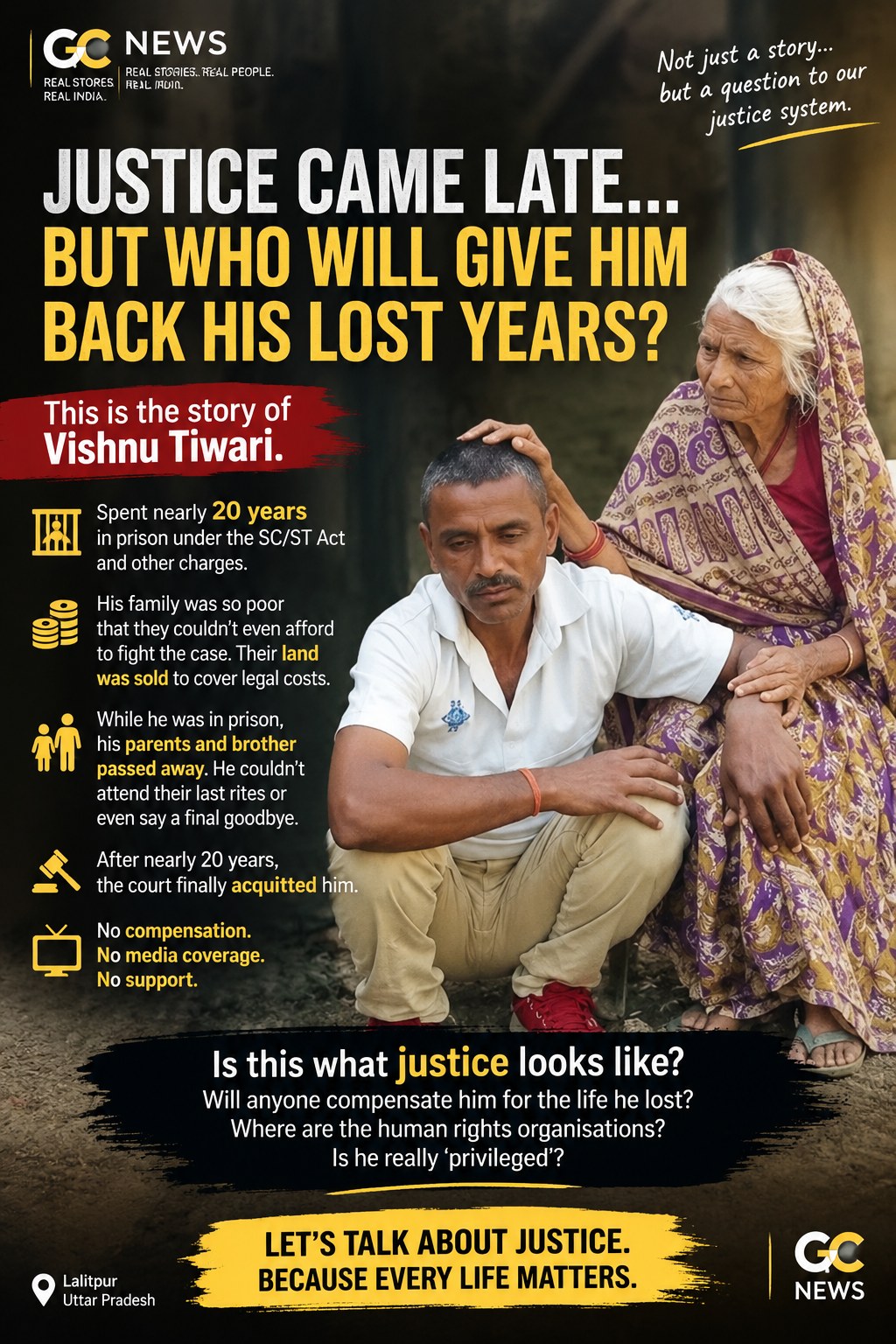
Some stories are difficult to read because they leave you with more questions than answers. The story of Vishnu Tiwari is one such story.
Vishnu Tiwari, from Lalitpur, Uttar Pradesh, spent nearly two decades in prison after being accused in a criminal case. He was booked under the SC/ST Act and other provisions and remained behind bars for years while his case went through the legal process.
Eventually, after almost 20 years, he was acquitted by the court.
But by the time Vishnu walked out of prison, there was no way to return to the life he had left behind.
During his years in prison, Vishnu lost his parents and his brother. He was away from his family when they needed him most. According to accounts of his case, he was not able to attend their final rites or even say a final goodbye.
Imagine spending years waiting for your case to end, only to discover that some of the people you loved most are no longer there when you finally return home.
That is the part of this story that goes beyond court documents and legal arguments.
There was also a financial burden. His family reportedly struggled to bear the cost of the legal battle, and their land was sold to meet legal expenses. For a family already facing hardship, a prolonged court case can become an enormous burden.
And then came the acquittal.
For many people, an acquittal might appear to be the end of the story. But for someone who has spent nearly 20 years in prison, it can also be the beginning of another struggle: rebuilding a life that has already moved on without him.
The years are gone.
The family members who died cannot return. The opportunities missed cannot simply be recovered. The financial losses cannot automatically be reversed. And the emotional consequences of spending such a large part of one's life in prison cannot be measured easily.
This raises an important question: What happens to a person after an acquittal?
Is being released from prison enough?
What kind of compensation should a person receive if they have spent many years behind bars and are eventually acquitted?
Who helps them rebuild their lives?
And perhaps most importantly, who takes responsibility for the years that can never be returned?
These are not questions that should be asked only in Vishnu Tiwari's case. They are questions that any justice system must be willing to confront.
A justice system must protect society and hold guilty people accountable. But it must also ensure that people who are ultimately acquitted are not left to face the consequences of years of incarceration entirely on their own.
There is also a larger issue here: access to justice.
For someone from a poor family, a long legal battle can be devastating. Legal expenses can consume savings, property can be lost, and families can be pushed deeper into financial hardship. The law may be equal in principle, but the ability to fight a long legal battle is not always equal in reality.
Vishnu Tiwari's story therefore deserves attention not simply because of the length of his imprisonment, but because it forces us to look at what happens after the courtroom door closes.
An acquittal can clear a person's legal burden, but it cannot erase the years they have already lived through.
Twenty years is not a small amount of time. It is a significant part of a human life.
The real question is not only whether Vishnu Tiwari eventually walked free.
The question is whether justice can ever truly compensate a person for the life they lost while waiting for it.
That is a question worth asking.
Join the Conversation
Read Next
Centre Seeks Two Years to Frame OBC Creamy Layer Criteria for Children of PSU & Private-Sector Employees
“Youth for Equality, Political Associations and Fundraising: Questions Neha Das Should Answer
Why Are India’s Gen Z Protest Movements Growing? Understanding the New Wave of Youth Politics
Subscribe to GC News
Get the latest independent journalism and updates straight to your inbox.