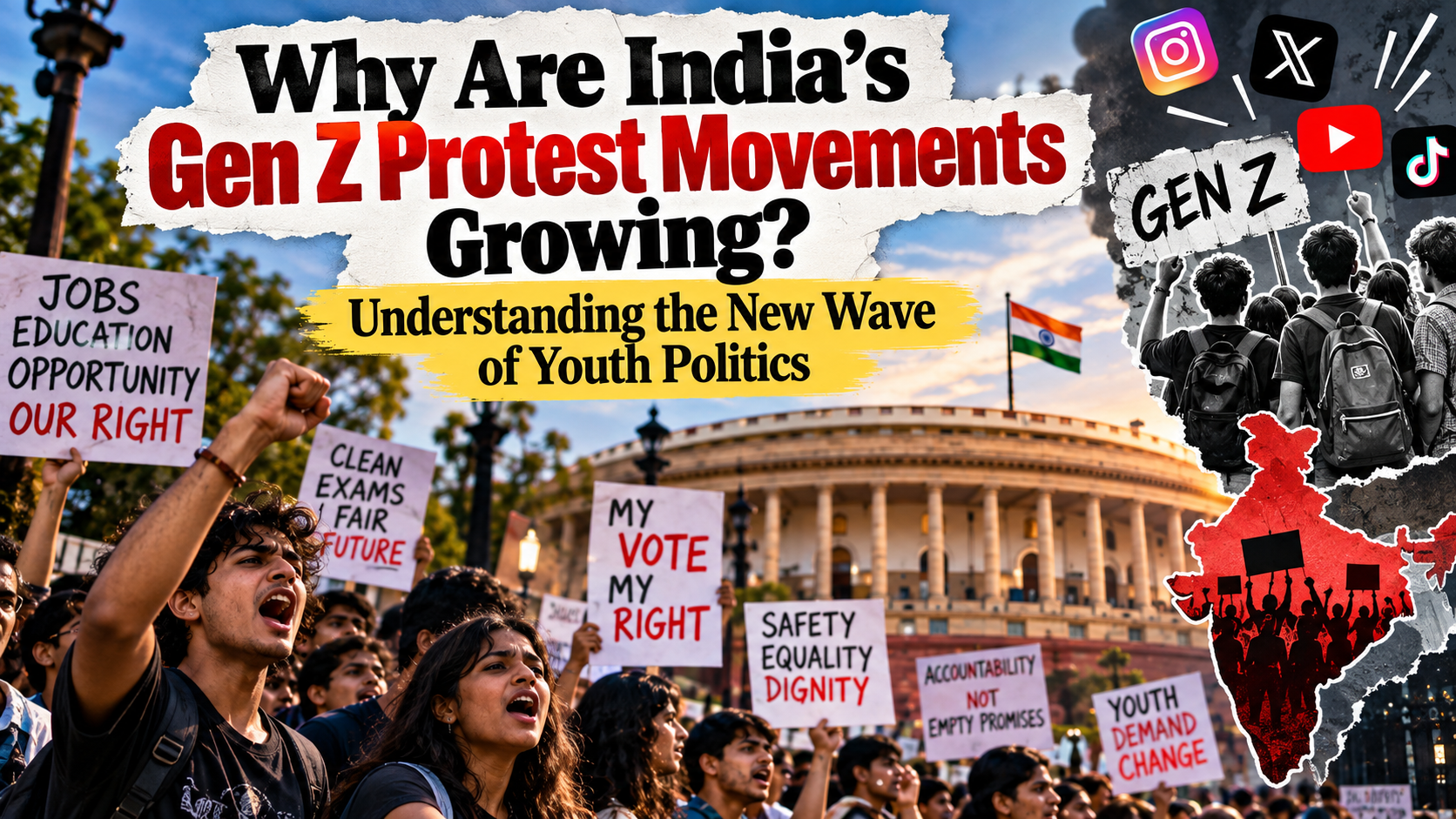
India’s Gen Z Protest Movements Growing? Understanding the New Wave of Youth Politics in 2026-2027
There was a time when a young person's political involvement in India was fairly easy to recognise. It might mean joining a student organisation, attending a political meeting, putting up posters on a college campus or eventually becoming a member of a political party.
That picture is changing.
Today, a political conversation can begin with a phone camera, a WhatsApp group, an Instagram post or a short video. A student can record a problem outside a college, post it online and find thousands of people discussing the same issue within hours. A complaint about an examination can turn into a protest. A protest can become a movement. And a movement that starts with one issue can eventually begin asking much bigger questions about how institutions work.
India's young population is not a single political group, and it would be wrong to describe an entire generation as having one ideology. But something interesting is happening among a section of young Indians: they are becoming more willing to question institutions publicly and organise outside traditional political structures.
The events of 2026 have brought that change into sharp focus.
On October 2, supporters of the youth-led Cockroach Janta Party (CJP) protested in Mumbai and launched a wider campaign demanding the resignation of Chief Election Commissioner Gyanesh Kumar. The protesters have alleged irregularities in voter-list revisions and accused the Election Commission of actions that could disadvantage eligible voters. The Election Commission and the government have rejected allegations that electoral-roll changes were politically designed, saying the revision process is intended to address duplicate, deceased and otherwise ineligible entries.
The same day also saw student and civil-society protesters in Delhi facing police restrictions and detention, according to reports.
Whatever one's political position, the development is significant for another reason. A youth movement that emerged from online frustration and examination-related concerns has moved into a debate about electoral institutions.
That raises a much bigger question:
Why are some young Indians becoming more politically active, and why are they choosing protests, social media and independent movements rather than relying entirely on established political organisations?
The answer is not one thing. It is a combination of education, employment, technology, frustration, political awareness and changing expectations about how citizens should be treated by institutions.
A Generation Growing Up Online
The most obvious difference between today's young political participants and previous generations is the environment in which they grew up.
For many members of Gen Z, the internet was not something that arrived after childhood. It was already part of everyday life.
News comes through phones. Friends communicate through messaging apps. Political speeches appear alongside entertainment videos. A government announcement can be discussed online before a television news bulletin has finished reporting it.
That has changed the speed of political communication.
A person no longer needs to wait for a newspaper to publish a story the following morning. They can watch an event live, record it themselves and immediately share their version of what happened.
This has created opportunities for young people who might otherwise have had very little access to the political conversation.
At the same time, it has created a serious problem: information moves quickly, but verification does not always move at the same speed.
A video can go viral before anyone checks where it came from. A claim can be repeated thousands of times without becoming true.
That tension—greater access to information but also greater exposure to misinformation—is one of the defining features of digital-age politics.
The Examination Problem
To understand the current youth movement, it is necessary to look at education.
Competitive examinations occupy an enormous place in the lives of Indian students. For many young people, an examination is not simply a test of academic knowledge. It can decide whether they enter a university, obtain a government job or spend another year preparing.
Students invest years of their lives in these examinations.
Families spend money on coaching and accommodation. Students move to cities known for competitive-exam preparation. Some postpone employment, relationships and other plans because they believe one successful examination can change the direction of their lives.
That makes examination irregularities particularly sensitive.
A paper leak or cancellation is not experienced by a student as a minor administrative inconvenience. It can feel like months or years of preparation have suddenly been put at risk.
The CJP rose to national attention earlier in 2026 after leading protests connected with examination paper leaks. Reuters reported that those protests became a major youth mobilisation and were followed by the resignation of Education Minister Dharmendra Pradhan.
That episode appears to have changed the political confidence of some young activists.
They discovered that an issue affecting students could attract national attention.
And once young people see that collective action can produce political consequences, the threshold for future mobilisation may become lower.
Jobs and the Pressure of Becoming Independent
Education naturally leads to another subject: employment.
A young person can spend years obtaining a degree and still struggle to find a job that matches their expectations.
Official figures show that India's youth unemployment rate for people aged 15–29 was 9.9% in 2025, down from 10.3% in 2024. Urban youth unemployment stood at 13.6%, compared with 8.3% among rural youth.
The decline is important and should not be ignored.
But statistics do not capture the entire experience of young people entering the labour market.
For a 23-year-old graduate, unemployment can mean something very personal.
It can mean continuing to depend on parents. It can mean delaying marriage or moving out of home. It can mean preparing for another examination because there are few alternatives. It can mean accepting work that does not use the education the person spent years acquiring.
There is also a difference between having a job and having a job that provides a sense of security and upward mobility.
This is one reason employment remains an important part of youth politics.
Young people are not only asking, “Is there work?”
Increasingly, they are asking:
“What kind of future can I build with the education I have received?”
Why Government Jobs Still Matter So Much
The attraction of government employment illustrates the problem.
Government jobs continue to be highly competitive because they are associated with stability, regular income and social security.
Every year, huge numbers of young people prepare for a relatively limited number of positions.
That creates a high-pressure environment.
If a recruitment examination is delayed, cancelled or affected by allegations of malpractice, the consequences can be enormous.
The frustration does not necessarily remain confined to the examination hall.
It can spill over into politics.
A student who spends years preparing for a public examination may begin asking questions about recruitment systems, administrative accountability and political responsibility.
In that sense, examination politics is often about much more than examinations.
It is about trust.
From “Why Me?” to “Why Is the System Like This?”
Perhaps the biggest change is psychological.
A young person facing an institutional problem may once have thought, “There is nothing I can do.”
Social media has changed that feeling.
The person can now find others facing the same problem.
Someone creates a group.
Another person shares documents.
Someone else contacts a journalist.
A fourth person organises a protest.
Suddenly, an individual problem becomes a collective issue.
This is one of the reasons online communities can become politically powerful.
They allow people to discover that their frustration is not necessarily an isolated experience.
The CJP and the New Style of Political Protest
The Cockroach Janta Party is an unusual example of this new political culture.
Its name itself reflects the role of internet culture and satire in contemporary activism. The movement emerged from online frustration and subsequently developed a physical protest presence. Reuters reported that the group gained prominence through examination-related protests before turning its attention to electoral issues.
That trajectory is worth noticing.
Traditional political movements often begin with an ideology, a party structure or an established organisation.
The newer model can begin with frustration.
First comes the meme.
Then the discussion.
Then the hashtag.
Then the meeting.
Then the protest.
Eventually, the organisers have to decide whether they want to remain an activist movement or become a political organisation.
That last step is difficult.
A protest can bring thousands of people together around one issue. Running an organisation requires something else entirely: policy, funding, leadership, internal discipline, candidates, local structures and a long-term strategy.
Whether youth-led movements can make that transition is one of the interesting questions for Indian politics.
Why the Election Commission Has Become Part of the Debate
The latest protests have moved the youth movement into more sensitive territory.
The focus is now partly on electoral rolls.
The protesters allege that changes to voter lists have affected eligible voters and are demanding accountability from the Election Commission.
These claims remain contested.
The Election Commission and the government have denied allegations that voter-roll revisions were undertaken to favour a particular political party. The Commission has said that electoral revision is intended to identify and remove duplicate, deceased and ineligible entries while ensuring eligible citizens are included.
This distinction is important.
A protester's allegation is not automatically an established fact.
At the same time, the existence of a dispute over electoral rolls is itself a legitimate subject of public scrutiny because voter registration goes to the heart of democratic participation.
On October 2, the Election Commission directed officials to register newly eligible voters and those previously omitted from electoral rolls, according to Reuters.
The controversy shows how youth politics can move from questions about jobs and examinations to questions about democratic institutions themselves.
Why Social Media Makes These Movements Different
There is another important factor: speed.
Imagine a traditional protest movement.
Someone needs to organise a meeting. People need to be contacted. Posters need to be printed. A venue needs to be arranged.
Digital platforms can compress that entire process.
A message can reach a large audience almost instantly.
This is particularly useful when the people involved are young and geographically dispersed.
A student in Delhi can communicate with another student in Kolkata, Mumbai or Bengaluru without ever meeting them.
That creates the possibility of national youth movements built around common concerns.
The October 2 protests were planned across several cities, with CJP announcing demonstrations in Mumbai and plans for activity in Goa, Kolkata and Bengaluru.
This kind of geographical spread would have been much harder to organise without modern digital communication.
But Going Viral Is Not the Same as Being Right
There is a danger here.
The internet rewards attention.
A calm explanation of a complicated electoral procedure may receive less attention than an angry 30-second video.
A carefully qualified statement—“there are allegations, but the evidence is still being examined”—does not travel as easily as “the system has been stolen.”
This creates an incentive for political communication to become more dramatic.
Young activists are not uniquely responsible for this problem. Politicians, journalists, influencers and ordinary users all operate within the same attention economy.
But youth movements are particularly dependent on digital platforms.
That makes media literacy essential.
Before sharing a political claim, a responsible citizen should ask a few simple questions:
Who made the claim?
What evidence has been presented?
Can the information be independently verified?
Is the material current?
Is the statement describing a fact, an allegation or an opinion?
Those questions may sound basic, but they are increasingly important.
The Decline of Patience With Institutions
Another theme running through youth activism is impatience.
Older generations may remember a time when citizens expected government offices, universities and other institutions to move slowly.
Today's young people have grown up with instant communication.
They order something online and receive tracking updates.
They can transfer money in seconds.
They can speak to someone on another continent immediately.
So when a government department takes months to answer a question, or when an examination authority gives unclear information, the contrast can be frustrating.
Young citizens increasingly expect institutions to communicate quickly and clearly.
That does not mean every demand can be met immediately.
Governments and public institutions often deal with complicated legal and administrative processes.
But silence can create distrust.
When institutions do not explain themselves, someone else usually fills the information gap.
On social media, that “someone else” may not necessarily have accurate information.
Is Gen Z Anti-Politics?
Not necessarily.
In fact, the current protests could suggest almost the opposite.
Young people who spend their time protesting an institution are engaging with politics.
They are not necessarily rejecting democracy.
They may be demanding that democratic institutions work differently.
That distinction matters.
There is a difference between saying, “I do not care about politics,” and saying, “I care enough about politics to protest.”
The latter is political participation.
The real question is whether that participation remains constructive.
The Role of Women and Student Safety
Youth politics is also developing around issues that are intensely personal.
Women's safety is one example.
For young women, political questions are not always about Parliament or elections. They can involve something as ordinary as travelling home after college.
A street without adequate lighting, harassment near a campus or unsafe public transport can become a political issue because these problems affect everyday freedom.
This is an important characteristic of modern youth activism.
Politics is increasingly connected to lived experience.
Students may not begin by discussing constitutional theory.
They may begin by asking why they cannot safely walk home.
The political question comes afterwards:
Who is responsible, and what can be done about it?
Young Voters Are Not One Political Block
It is tempting to talk about “Gen Z” as though it represents a single political identity.
That would be a mistake.
India's young population is enormous and extremely diverse.
A student in a metropolitan city may have completely different priorities from a young person in a rural district.
Someone preparing for a government examination may see the economy differently from a technology worker.
A first-generation college student may have different concerns from someone whose parents are already professionals.
Language, region, income, education and family background all matter.
So the rise of youth activism should not be interpreted as evidence that young Indians have suddenly adopted one political ideology.
The more visible change is in how some young people participate.
The style is more digital.
The communication is faster.
The language can be informal.
The organising can be decentralised.
And the issues can change quickly.
Why Humour Has Become a Political Tool
One of the strangest features of modern political activism is the role of humour.
Memes can carry political messages.
Satire can attract people who would never attend a conventional political meeting.
A joke can become a slogan.
A slogan can become a symbol.
The CJP's own identity demonstrates this relationship between internet culture and political mobilisation. Reuters reported that the movement's name was adopted from a derogatory “cockroach” reference and subsequently became part of its political identity.
There is a certain logic to this.
Humour makes politics feel less distant.
A formal political speech can seem inaccessible to a young person.
A meme does not.
That does not mean humour makes political movements superficial.
Sometimes satire is precisely what allows people to discuss serious subjects.
The Problem With Permanent Outrage
There is, however, another side to digital politics.
If every issue is presented as a crisis, people eventually become exhausted.
A movement that is constantly angry may find it difficult to distinguish between genuinely serious institutional failures and ordinary political disagreements.
There is also the risk of personal abuse.
Political criticism can easily become harassment.
That can discourage reasonable discussion and push people into opposing online camps.
For youth politics to mature, activism will need to develop alongside restraint.
Being politically active does not require being permanently angry.
Protest Is Only the Beginning
A successful protest can bring attention to a problem.
But attention is not the same as reform.
If students want better examination systems, somebody has to design better procedures.
If young people want more employment, policies have to create productive jobs.
If citizens want accurate voter lists, electoral authorities need reliable verification systems.
If protesters want safer streets, governments need to improve infrastructure and policing.
That is where political movements face their real test.
It is comparatively easy to say what is wrong.
It is much harder to explain exactly what should replace it.
The strongest youth movements will therefore need to move beyond protest slogans and develop concrete proposals.
What Established Political Parties Can Learn
Traditional political parties are watching these developments carefully.
Young voters are increasingly comfortable with politicians who communicate directly through digital platforms.
The old model—press conference, newspaper report, television interview—is no longer the only route to an audience.
But copying the style of social media is not enough.
Young people can often recognise when a message has been designed by a professional political communications team.
Authenticity matters.
So does responsiveness.
A young voter may forgive a politician for disagreeing with them.
They may be less forgiving if they believe the politician is simply ignoring them.
This could push established political parties to change the way they communicate with younger citizens.
What Institutions Can Learn
The lesson is not only for political parties.
Government institutions also have something to learn.
Clear communication matters.
When an examination is cancelled, students want to know why.
When an electoral roll is revised, voters want to know how the process works.
When a policy changes, citizens want accessible explanations.
Silence creates space for rumours.
The faster information travels, the more important institutional communication becomes.
That does not mean every accusation must be accepted.
It means institutions need to explain decisions clearly enough that citizens can examine the evidence for themselves.
Could This Become a Long-Term Political Movement?
That remains uncertain.
Some protest movements disappear once the immediate issue is resolved.
Others evolve into organisations.
A few become political parties.
The CJP has already moved further along this path than a typical online campaign, but its long-term political influence cannot yet be established.
The October 2 demonstrations show that it can mobilise supporters around a new issue, while the organisation has announced plans for protests in additional cities.
Whether that momentum can be sustained is a different question.
A political movement needs more than visibility.
It needs people willing to remain involved when the cameras leave.
The Bigger Economic Question
Behind much of youth frustration lies a basic question about the future.
Will I be able to build an independent life?
That question connects several seemingly unrelated issues.
Education connects to employment.
Employment connects to income.
Income connects to housing.
Housing connects to family decisions.
And all of these eventually connect to politics.
The latest PLFS data show that 25% of Indians aged 15–29 were estimated to be not in employment, education or training in 2025.
That does not mean all of these young people are politically dissatisfied.
But it does show the scale of the transition facing India's younger population.
India is educating more young people and connecting them to the digital world at an extraordinary pace.
Their expectations are rising too.
Political institutions will increasingly be judged not only by ideology, but by whether young people believe they have a realistic future.
A More Direct Form of Citizenship
Perhaps the most important change is that young Indians increasingly see themselves as participants rather than spectators.
They can question.
They can record.
They can organise.
They can publish.
They can protest.
They can vote.
And they can hold public institutions to account.
This does not mean every online campaign is correct.
It does not mean every protest demand is justified.
It does not mean every allegation is true.
But it does mean that the distance between ordinary citizens and public institutions has become smaller.
That is a profound change.
What India's Gen Z Could Bring to Politics
If the current movement develops further, its greatest contribution may not be the creation of another political party.
It may be a change in political expectations.
Young citizens may increasingly demand:
-
faster responses from institutions;
-
greater transparency;
-
cleaner examination and recruitment systems;
-
better employment opportunities;
-
safer public spaces;
-
accessible government information;
-
accurate electoral rolls;
-
and greater accountability from people in positions of power.
Those demands are not inherently left-wing or right-wing.
They are questions about governance.
The political answers to them will differ, but the underlying demand for functioning institutions can cut across ideological boundaries.
The Challenge Ahead
The challenge for India's young political activists is to convert energy into sustained civic participation.
Protests can bring attention.
Social media can create visibility.
But democratic change ultimately requires institutions.
That means learning how laws work, understanding constitutional rights, examining evidence, participating in elections and engaging with public policy.
It also means accepting that disagreement is part of democracy.
A movement becomes stronger when it can defend its own claims with evidence and respond seriously to opposing arguments.
The same standard should apply to governments, political parties, journalists and citizens.
Conclusion
India's Gen Z is not a single political force, and there is no single explanation for the rise in youth activism.
The reasons are spread across everyday life.
There is anxiety about examinations.
There is competition for employment.
There is frustration with administrative delays.
There is a demand for safer public spaces.
There is growing interest in how elections are conducted.
And there is a generation that has the technology to organise around these concerns almost instantly.
The events of 2026 have made this increasingly visible.
The Cockroach Janta Party began with online frustration and examination-related activism and has now expanded its campaign to questions surrounding electoral rolls and the Election Commission. On October 2, 2026, supporters demonstrated in Mumbai, while protesters in Delhi faced police restrictions and detentions. The allegations surrounding voter-list revisions remain disputed: protesters and opposition groups have raised concerns, while the Election Commission and government have denied claims of politically motivated manipulation.
That distinction should remain at the centre of any serious discussion.
Youth activism deserves attention without automatically accepting every claim made by activists.
Institutions deserve scrutiny without automatically assuming that every allegation against them is true.
And political disagreement should not be confused with hostility towards democracy.
Perhaps that is the real story behind India's emerging youth politics.
Gen Z is not necessarily asking for politics to disappear.
It is asking politics to become more responsive.
A student worried about an examination wants an answer.
A graduate looking for work wants an opportunity.
A voter wants confidence that their name is correctly recorded.
A young woman wants to feel safe on her way home.
And a citizen who sees a problem increasingly believes they have the ability—and perhaps the responsibility—to speak about it.
That is a very different relationship with public life from the one many Indians grew up with.
Whether this generation eventually builds new political organisations, influences existing parties or simply changes the way governments are questioned remains to be seen.
But one thing is already clear:
India's youth are finding new ways to make themselves heard.
And in a democracy as large and diverse as India, the way that voice develops could become one of the defining political stories of the years ahead.
Join the Conversation
Read Next
Centre Seeks Two Years to Frame OBC Creamy Layer Criteria for Children of PSU & Private-Sector Employees
20 Years Behind Bars: The Untold Story of Vishnu Tiwari
“Youth for Equality, Political Associations and Fundraising: Questions Neha Das Should Answer
Subscribe to GC News
Get the latest independent journalism and updates straight to your inbox.