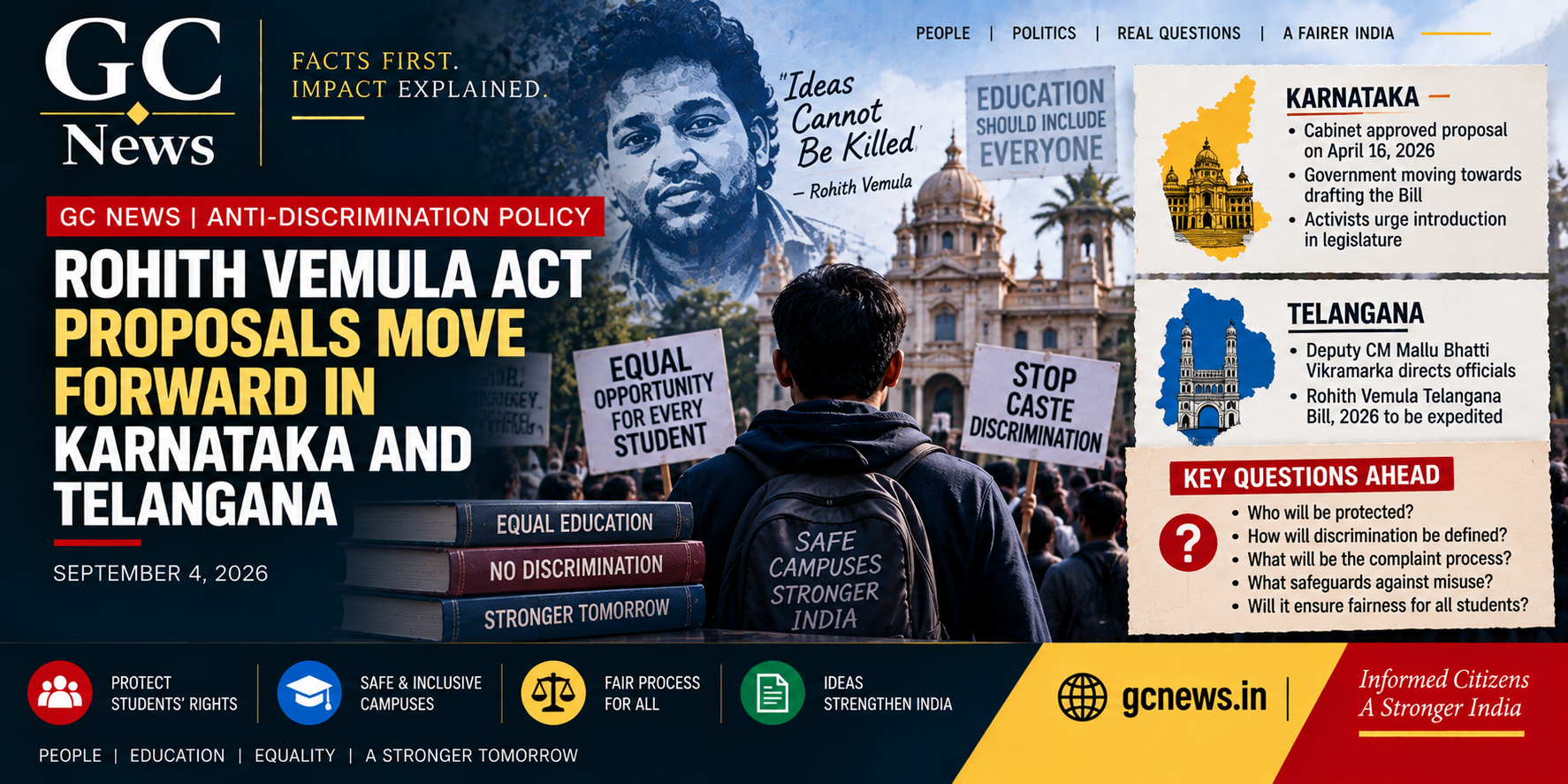
Karnataka and Telangana are moving ahead with proposed legislation popularly known as the “Rohith Vemula Act,” aimed at strengthening protections against caste and identity-based discrimination in higher educational institutions.
In Karnataka, the State Cabinet had approved the proposal on April 16, 2026, and the government subsequently moved towards preparing the legislation.
Activists and student groups have also pushed for the Bill to be introduced and passed by the Karnataka legislature.
Telangana is considering its own version.
Deputy Chief Minister Mallu Bhatti Vikramarka has directed officials to expedite preparation of the proposed Rohith Vemula Telangana Bill, 2026.
Why Is It Called the Rohith Vemula Act?
The proposed legislation is named after Rohith Vemula, a University of Hyderabad PhD scholar whose death in 2016 triggered a nationwide debate over caste discrimination, student welfare and institutional accountability in higher education.
Since then, activists have repeatedly demanded stronger mechanisms for students who allege discrimination within universities and colleges.
The proposed laws in Karnataka and Telangana represent attempts to translate some of those demands into a statutory framework.
What Is Karnataka Proposing?
The Karnataka proposal is intended to address discrimination in higher educational institutions and create mechanisms through which complaints can be examined.
However, an important distinction needs to be maintained:
Until the final Bill is officially published, its exact definitions, protected categories, complaint procedures, penalties and safeguards cannot be treated as settled law.
Cabinet approval of a proposal also does not mean that the legislation is already in force.
The Bill would still have to complete the applicable legislative process before becoming law.
What Does It Mean for General Category Students?
A genuinely universal anti-discrimination framework could benefit students from every background by establishing clearer rules against discriminatory treatment.
For General Category students, however, an important question will be whether the final law protects every student against prohibited discrimination or creates particular protections and remedies for specified social groups.
Another important issue will be due process.
Students accused of discrimination should receive a fair opportunity to respond, while students making genuine complaints should have access to an effective and independent grievance mechanism.
The balance between those two principles will depend on the actual text of the legislation.
What Could It Mean for Marginalised Students?
The political campaign behind the proposed legislation has focused heavily on allegations of caste discrimination faced by students from historically disadvantaged and marginalised communities.
Supporters believe a dedicated law could provide stronger institutional accountability and clearer mechanisms for addressing such complaints.
But the precise scope of protection—including which groups are specifically covered—should be assessed from the final Bill rather than assumed before its publication.
Why This Matters
Few would dispute that students should be protected from genuine discrimination.
The important legal questions begin with how discrimination is defined, how allegations are investigated, what evidence is required, what penalties apply and what safeguards exist against misuse or arbitrary action.
Those details will determine whether the proposed legislation creates a balanced anti-discrimination framework.
Until Karnataka and Telangana publish their final legislative texts, the key questions remain:
Who will be protected? What conduct will legally constitute discrimination? How will complaints be investigated? And what protections will exist for both complainants and accused students?
Status: Proposed Legislation / Drafting Process
Based on reporting by The Economic Times and Bangalore Mirror. Exact provisions should be assessed once the respective governments publish the final Bills.
Join the Conversation
Read Next
Centre Seeks Two Years to Frame OBC Creamy Layer Criteria for Children of PSU & Private-Sector Employees
20 Years Behind Bars: The Untold Story of Vishnu Tiwari
“Youth for Equality, Political Associations and Fundraising: Questions Neha Das Should Answer
Subscribe to GC News
Get the latest independent journalism and updates straight to your inbox.